iGaming Payment Solutions
The only market we track where the rail is closed by statute · Verified 2026-07-31
iGaming payments in India
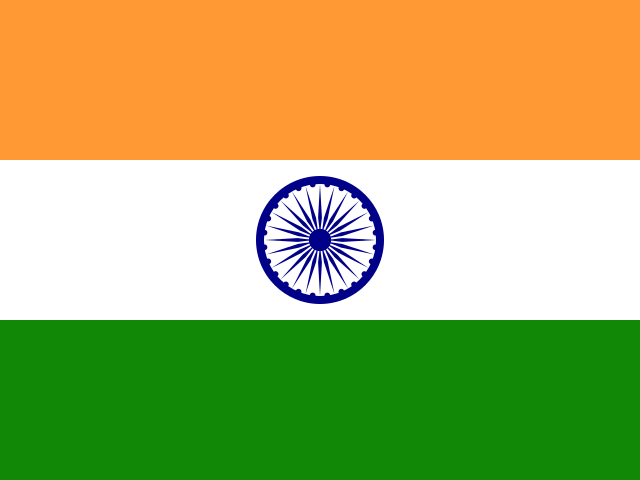 iGaming payments in
 Everywhere else, payments close because a regulator acts: an account is frozen, a paybill is withdrawn, a bank is told to stop. India closed the rail in the text of the law. Section 7 of the PROG Act says banks, financial institutions and anyone facilitating transactions may not process online money gaming payments at all: self-executing, no order required. The Act separately arms the state with blocking orders and search powers, but the rail itself is shut by the statute. We list India because competitors process here and readers should see who. We do not recommend it.
7
Providers with a rail here
1
Reach it directly
3
Rails tracked
INR
Settles in
Quick info
- Currency
- INR
- Region
- Asia
- Betting
- processing banned
- Casino
- processing banned
- Dominant rail
- Instant bank transfer / RTP
- Providers
- 7 (1 direct)
- Regulator
- OGAI
- Enforcement
- site blocking + payment blocking
A statutory bar is not aggressive enforcement
Why India cannot be compared with Indonesia, Kenya or Brazil
The distinction decides everything downstream. Enforcement-driven closure is a risk you can price: you assess how aggressive the regulator is, how exposed your provider is, and how fast you could migrate. A statutory bar is not a risk, it is a state. Section 7 of the Act prohibits banks, financial institutions and anyone else facilitating transactions or authorising funds from engaging in, permitting, aiding or abetting payment for an online money game. The transaction is unlawful for your counterparty as well as for you, which means it has no discretion to exercise in your favour and no incentive to fight for you. Compare Indonesia, where the same outcome is produced by pressure rather than by drafting.
| India: closed by statute | Indonesia, Kenya, Brazil: closed by enforcement | |
|---|---|---|
| Who decides | Parliament, in the text of the Act | A regulator, case by case |
| What a provider can promise | Nothing lawful | Best efforts, and a track record |
| Recourse if cut off | None; the bar is the law | Appeal, negotiate, or migrate |
| What would change it | A court striking the Act down, or Parliament | A change of policy or of counterparty |
| Exposure carried by the bank | Illegality | Regulatory displeasure |
| Who Section 7 reaches | How | Exposure |
|---|---|---|
| Banks and financial institutions | Named outright in Section 7 | Up to 3 years and up to INR 1 crore; 5 years and INR 2 crore on repeat |
| Payment aggregators and gateways | Caught by the catch-all: "any other person facilitating financial transactions or authorisation of funds" | Same escalation |
| Wallet operators | Caught by the same catch-all | Same escalation |
| Card networks and other fintech platforms | Caught by the same catch-all | Same escalation |
This is the part that distinguishes India from every other closed market on this site. The prohibition was drafted at the payment layer rather than being applied to it afterwards.
Three categories, and the skill defence erased
The Promotion and Regulation of Online Gaming Act, in force 1 May 2026
Indian gambling law rested for decades on a judicial line between games of skill and games of chance, and the real-money industry was built on the skill side of it. The Act erases the line. It sorts online games into three buckets and prohibits one of them outright, regardless of how much skill it involves.
| Category | Status under the Act | What it covers |
|---|---|---|
| E-sports | Recognised and promoted | Competitive play registered under the Act |
| Online social games | Permitted | Skill or entertainment play with no stake |
| Online money games | Prohibited outright | Any game played for a stake, skill or chance alike |
Offering, facilitating or advertising a prohibited game carries fines reported up to ₹1 crore and imprisonment up to three years. "Facilitating" is the word that reaches payment intermediaries.
The law is closed. The rail, for now, is not
Where the risk actually sits
It would be tidy to say UPI stopped working for offshore gambling on 1 May 2026. It did not. As of early 2026 UPI payments toward offshore sites were not systematically blocked; individual banks declined individual transactions, and intermediaries kept routing. The statute and the plumbing are out of step, and that gap is exactly where operators are living.
Reading that gap as an opportunity is the mistake. Nothing about it is a defence: a transaction that clears is still a transaction the Act prohibits, and the gap closes at whatever pace the banks and the NPCI choose. What it actually tells you is that anyone currently processing India volume is carrying legal exposure rather than operational risk, and pricing it as though it were the latter.
- UPIdominant
instant bank transfer
Statutorily barred for real-money gaming (PROG Act); offshore sites still route it grey via payment intermediaries; surface who can, flag the legal risk.
- Bank transfer / Netbanking (IMPS/NEFT)major
bank transfer
Under the same statutory bar as UPI: the PROG Act closes bank processing for prohibited games, so offshore routing rides on intermediaries rather than on bank cooperation.
- Paytm / PhonePemajor
e-wallet
Both sit on UPI rails and inherit the PROG Act prohibition. Their presence in a cashier says more about the intermediary behind them than about the wallet.
Counted from each provider's own recorded rail list, not from its presence in the market. A rail with one provider behind it is a single point of failure whatever the headline coverage number says.
The challenge is live, and the Act is not stayed
Hearing listed for 5 August 2026
The industry took the Act to the Supreme Court, arguing that a blanket ban is disproportionate and that erasing the skill and chance distinction is arbitrary. The case matters commercially for one reason: it is the only thing that could reopen the market. It has not done so.
21 August 2025done
Parliament passes the Promotion and Regulation of Online Gaming Act
22 August 2025done
Presidential assent
December 2025done
Supreme Court flags the need for a three-judge bench and defers the challenge
1 May 2026in force
Act and rules come into force; the Online Gaming Authority of India is established
5 August 2026ahead
Hearing listed before the three-judge bench. No stay has been granted, so the ban stands meanwhile (as of 31 July 2026)
What the industry was already carrying
The fiscal squeeze that preceded the ban
The ban did not arrive into a comfortable market. From October 2023 real-money platforms were taxed at 28% GST on the full face value of every bet rather than on gross gaming revenue, a base so wide that it exceeded many operators' entire margin, and player winnings above ₹10,000 in a financial year carried 30% withholding. The sector spent two years litigating that before the Act removed the question.
Why India is in this catalog at all
Shown, credited, and not recommended
We could leave India out. Competitors list India processing, so omitting it would make our catalog look less complete than theirs while telling a reader nothing. Instead we record which providers reach Indian rails and how, on the same evidence grades as everywhere else, and we say plainly what the entry is worth.
What our India entries do tell you
Who claims or is known to reach Indian rails
On the same evidence grades as every other market
How they get there
Direct, aggregated, via a local PSP or a wallet
That the capability exists at all
Which is a real competitive fact
What they do not
That the route is lawful
It is not; the Act bars processing
That the capability will persist
It closes when the banks close it
A recommendation
There is none to give for this market
Direct acquiring
1A direct relationship with the local rail rather than a hop through someone else's.
- PayUindustry knowledge
Rails named: UPI, Netbanking
Aggregated or indirect
6The rail is reachable, but through an aggregator, a local PSP or a wallet rather than directly.
Evidence grades run from named clients through platform catalogs and industry knowledge down to a provider's own claim. A claim we could not corroborate is still shown, labelled as what it is. See our methodology.
Markets that run on the same rail
Where a cashier built for this market mostly transfers, and where it does not